

What to Expect During Your Piano Restoration
It sits in your home, a silent guardian of memories. It might be the piano your grandmother played, the instrument you practiced on as a child, or a vintage find that you’ve always dreamed of bringing back to life. But now, it’s a shadow of its former self. The finish is faded, the keys stick, and the sound is a dull, hollow echo of the music it once made.
You know it has potential. You know it deserves a second life. But the thought of "restoration" is daunting.
What does it actually involve? Where do you even begin? Who can you trust with such a precious and complex heirloom? The process can feel like a black box, a leap of faith that leaves you full of questions: "Will it be worth it?", "How long will it take?", and "What if I don't like the result?"
At The Piano Boutique, we believe that transparency is the antidote to anxiety. We believe that you, as the owner of the instrument, should be a partner in its renewal. Our restoration process isn't a secret; it's a meticulous journey that we want to share with you.
This is a complete, step-by-step guide to what you can expect when you entrust your piano to our team. This is the process that transforms a tired heirloom into a concert-level instrument, all under the personal direction of our founder, a master piano artisan.
The Philosophy of True Restoration
First, it is crucial to understand what "restoration" truly means. This term is often used loosely, but in the world of high-level piano work, it has a very specific meaning.
Refinishing: This is purely cosmetic. It's stripping and respraying the cabinet. This does nothing for the sound or playability of the piano.
Reconditioning: This is a "tune-up" for the piano's engine. It involves cleaning, repairing, and adjusting existing parts. This can be a good option for a piano that is in decent shape, but it won't fix major underlying structural or mechanical issues.
Restoration / Rebuilding: This is what we do. This is a complete, "frame-off" renewal of the entire instrument. We are not just fixing what's broken; we are systematically replacing all the core "wear" components—the strings, the pinblock, the hammers, the action parts—to return the piano to its original factory-new condition, or often, even better.
A true restoration respects the piano's original design and soul while integrating the best of modern materials and techniques. It's a process that, according to the Piano Technicians Guild, addresses the piano's three main components: the belly (sound structure), the action (moving parts), and the cabinet.
This level of work is not a "quick fix." It is an art form.
It Starts With the Artisan: The Piano Boutique Difference
A factory can "rebuild" a piano. An artisan restores it.
The most critical factor in your piano's restoration is not the brand of new parts; it's the hands and ears of the person leading the project. At The Piano Boutique, that person is our founder, Michael Ierullo.
Michael is a master craftsman and certified concert piano technician with over 40 years of experience. He doesn't just manage a team; he is personally involved in the most critical stages of every restoration project. His expertise means that decisions are not based on a checklist; they are based on a deep, tactile understanding of how a piano functions as a single, harmonious system.
When we talk about "The Piano Boutique Process," we are talking about a master-apprentice model, not an assembly line. This expertise is your greatest assurance of quality.
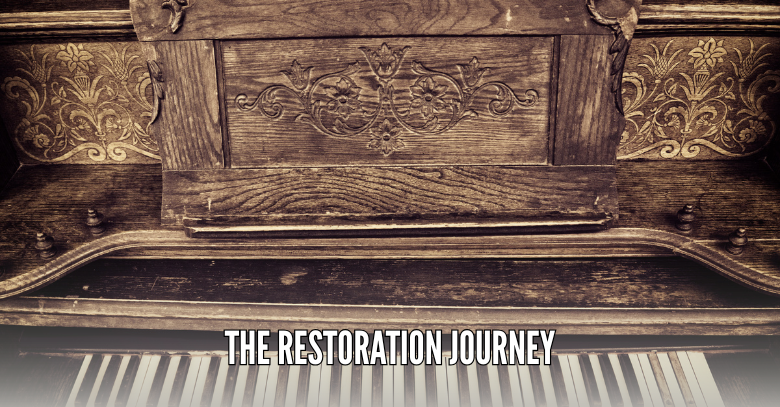
The Restoration Journey: A Step-by-Step Guide
We have broken down our entire process into five distinct phases, from our first conversation to the moment you play the finished instrument in your home.
Phase 1: The Consultation and Comprehensive Appraisal
This is the most important phase for you as a client. It's where we build a plan together and establish a foundation of trust.
Step 1: The Initial Conversation
When you first call us or visit our showroom, we’ll start by listening. We want to hear the story of your piano.
What is its history?
What are your goals for it? (e.g., family heirloom, professional practice instrument, a showpiece for your home).
What are your concerns? (e.g., sticking keys, a "dead" sound, the cosmetic finish).
What is the piano's make, model, and serial number (if you have it)?
Step 2: The In-Home Technical Assessment
If the initial conversation suggests the piano is a potential candidate, we will schedule a visit from one of our expert technicians. This is a deep, diagnostic inspection. We are, in effect, performing a "physical" on your piano to determine its true condition.
Here is what we are looking for:
The "Belly" (The Sound Structure): This is the core of the piano and the most critical area.
Soundboard: We look for cracks in the wood. More importantly, we check for "crown" — the subtle, upward curve of the soundboard that is essential for a rich, projecting tone. If the soundboard is flat or has lost its crown, the piano's voice will be weak.
Bridges: We inspect the wooden bridges (which transmit the string's vibration to the soundboard) for cracks or "checking."
Pinblock: This is the laminated hardwood block, hidden under the plate, that holds the tuning pins. We test the "torque" of the tuning pins. If they are loose, the piano can no longer hold a tune. A failed pinblock is non-negotiable and must be replaced in any true restoration.
Plate (Harp): We inspect the cast-iron plate for any cracks or structural failures (this is rare, but catastrophic if missed).
The Action (The Engine): This is the entire 12,000-part mechanism that connects your fingers to the strings.
Hammers: Are the felts deeply grooved? Are they flattened and hard as a rock? This is the primary source of a "tinny" or "bright" sound.
Action Centers: We check all the tiny hinge pins for sluggishness (often from humidity) or looseness (from wear and tear).
Key Bushings: We check the felt lining the keys for wear, which results in that "click-clack" sound when you play.
Keys: Are any keytops (the white and black surfaces) chipped or missing? Are the keys themselves warped or unlevel?
The Cabinet:
We inspect the structural integrity of the legs, the lid, and the main case.
We assess the condition of the finish and any veneer that may be peeling, chipped, or damaged by water.
Step 3: The Transparent Estimate
Back at our shop, our team convenes with Michael Ierullo to review the technical assessment. We determine exactly what your piano needs to be its best self.
We will then present you with a comprehensive, itemized estimate. This document is not a single, vague number. It is a detailed plan that outlines:
Required Work: The items we believe are structurally and mechanically essential (e.g., new pinblock, new strings, new hammers).
Recommended Work: The items that are highly advised for a full restoration (e.g., new repetitions, key re-bushing).
Cosmetic Options: The different choices for refinishing the cabinet (e.g., classic satin ebony, high-polish polyester, or a natural wood grain).
We will walk you through this estimate, line by line, answering every question. You will know exactly where every dollar is going. There are no hidden fees and no up-sells. You are in complete control of the final decision.
Phase 2: The White-Glove Transportation
Once you approve the restoration plan, the journey begins.
A piano is not furniture. It is a 500- to 1,000-pound instrument of delicate wood and high-tension steel. It cannot be moved by a standard moving company.
We dispatch our team of professional, fully insured piano movers. They are specialists who do nothing but move pianos. They have the training and custom equipment (like skid boards, grand piano dollies, and protective padding) to safely navigate your home, including stairs, tight corners, and condo elevators.
Your piano is carefully wrapped and secured in a climate-controlled truck for its safe passage to our state-of-the-art restoration workshop in Toronto. This same team will be the one to bring it back to you. Your peace of mind is our first priority.
Phase 3: The Atelier - Where the Transformation Happens
This is the longest and most detailed phase. Your piano is carefully dismantled, and every component is moved to a specialized station within our workshop.
Step 1: Meticulous Disassembly & Blueprinting
Before a single screw is turned, the piano is photographed extensively. As we disassemble it, every part—from the smallest flange to the largest lid—is labeled, cataloged, and stored in a "project bay" that is dedicated exclusively to your instrument. We do not mix parts between pianos.
Step 2: "Belly" & Structural Restoration (The Soul)
This is the heavy, foundational work that creates the piano's voice.
The Teardown: The 220+ strings are removed, releasing over 40,000 pounds of tension. The massive cast-iron plate is unbolted and carefully lifted out by a crane. This reveals the "guts" of the piano: the soundboard and the pinblock.
Pinblock Replacement: The old, failed pinblock is chiseled out from the piano's case. A new one, custom-fit and made of the highest-grade, multi-laminate rock maple, is installed. This is the new "foundation" that will ensure your piano holds a perfect tune for the next 50-70 years.
Soundboard Restoration: If the original soundboard is structurally sound but has minor cracks, we meticulously repair and "shim" them with new spruce. If the soundboard is "dead" (has no crown), we will have recommended a full replacement. This involves installing a brand-new, quarter-sawn Sitka spruce soundboard, complete with new ribs, all carefully "crowned" to produce a powerful, resonant tone.
Bridge Restoration: The bridges are repaired or replaced, and new pinholes are drilled. The top of the bridge is "graphited" for a smooth-bearing surface.
Plate Restoration: The cast-iron plate is taken to our finishing bay. It is stripped down to the bare metal, meticulously hand-sanded to remove casting imperfections, and then re-gilded. We typically use a high-end, satin-bronze or gold finish, just like the original, and re-apply the hand-lettering (e.g., "Steinway & Sons") for a stunning, like-new appearance.
Restringing: The newly-gilded plate is re-installed and bolted down. Now, the piano is re-strung. We use the highest-quality steel piano wire for the treble strings. The copper-wound bass strings are custom-manufactured for your piano's specific "scale" (design) to ensure a deep, clear, and powerful bass.
Step 3: Action Restoration (The Engine)
While the "belly" work is happening, the entire piano "action" (the keyboard and all its moving parts) is on a workbench being completely rebuilt. This is one of the many Piano Services our founder has perfected over 40 years.
Key Restoration: All 88 keys are removed. The old, worn-out felt "bushings" (which guide the key) are replaced, ensuring a silent, precise key-press. The original keytops are cleaned and buffed. If they are badly damaged (e.g., chipped plastic or broken ivories), we replace them with a modern, high-grade synthetic that mimics the feel and texture of ivory. The keys are then "leveled" on the keybed to be perfectly even.
New Hammers, Shanks, and Flanges: This is a 100% replacement. We do not "file" old, dead hammers. We install a brand-new set of professional-grade hammers (from top-tier German makers like Renner or Abel) along with all-new shanks (the wooden sticks) and flanges (the hinges).
New Repetitions (Wippens): In a grand piano, the "repetition" is the most complex part of the action. It's what allows a key to be played rapidly. We replace the entire assembly with new, modern parts to give you the fast, responsive, and reliable touch of a brand-new concert piano.
Step 4: Cabinet Refinishing (The Beauty)
The piano's case (the lid, the rim, the legs, the music desk) is in its own dedicated, dust-free finishing department.
Stripping: The old, cracked, and faded finish is carefully stripped by hand.
Veneer & Wood Repair: Any damaged wood or chipped veneer is expertly repaired, with our artisans matching the grain and color of the original wood.
Finishing: This is a multi-week process. We do not "paint" a piano. We apply multiple (often 10-15) layers of high-grade lacquer or polyester. Between each coat, the finish is allowed to cure and is then wet-sanded to achieve a perfectly smooth, deep, and lustrous finish. You choose the final look: a classic, hand-rubbed satin or a breathtaking, mirror-like high polish.
Phase 4: Reassembly, Regulation, and Voicing (The "Magic")
This is where the hundreds of hours of work and thousands of new parts come together to become a single, living instrument.
Assembly: The newly-refinished cabinet is reassembled. The newly-rebuilt action is carefully "mated" back into the piano case.
Rough-Tuning: The new strings have incredible tension and need to "stretch." We perform multiple "pitch-raise" tunings to gradually bring the piano up to the A440 concert pitch and stabilize it.
Action Regulation: This is the most painstaking, time-consuming, and critical step of the entire process. Regulation is the calibration of all 12,000 moving action parts. Our master technicians, under Michael's supervision, spend 40-60 hours per piano, making microscopic adjustments to ensure:
The "touch weight" of every key is perfectly consistent.
The "let-off" (the point where the hammer escapes) is precise.
The dampers lift and fall silently and perfectly.
This is the step that separates a "playable" piano from an exceptional one.
Voicing (The "Art"): This is Michael Ierullo's signature. Regulation makes a piano play perfectly; voicing makes it sing beautifully. Voicing is the art of adjusting the piano's tone. Using special needles, Michael meticulously works the felt of each of the 88 hammers to change its density and hardness.
Is the tone too "bright" or "glassy"? We needle the "shoulders" of the hammer to soften it.
Is the tone too "dull" or "muddy"? We may use a special lacquer to add a bit of "life" to the felt.
This process is subjective, delicate, and is what gives the piano its final "personality" and "color."
Phase 5: Final Delivery, In-Home Tuning, and Aftercare
The journey is complete. We will contact you to schedule the final delivery.
The Return: Our same professional piano moving team will bring your restored piano back to your home, carefully placing it in the spot you've chosen.
The "Settling" Period: Your piano has just been on a big journey. It needs 2-4 weeks to "acclimatize" to your home's unique temperature and humidity. The new strings will also continue their final stretching. This is completely normal.
The Final In-Home Tuning: After this settling period, we will send our concert technician to your home for a full, fine Piano Tuning and to perform any minor regulation or voicing "touch-ups" that are needed now that the piano is in its new environment.
Your Warranty: We stand behind our work. Every full restoration from The Piano Boutique comes with a comprehensive warranty, giving you complete confidence and peace of mind in your new investment.
Your Piano's Next Chapter Begins Here
A piano restoration is a story of transformation. It’s a partnership between you and an artisan, a process of breathing new life into an instrument that has given so much. The result is not just a "fixed" piano; it is your family's heirloom, reborn. It is a world-class instrument with a rich history and a brand new future.
You can see the stunning results of this exact process by browsing our Rebuilt Steinway Collection—each one a testament to this meticulous journey.
If you have a piano that you believe is ready for its next chapter, we invite you to start the conversation. Let us help you unlock the music that's still locked inside.
Call our restoration experts anytime at +1 (416) 889-8667 or visit our Contact Us page to schedule your initial consultation. Let's build a plan for your piano's legacy.